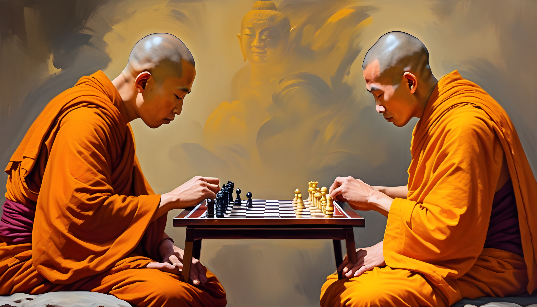
Buddhist Wisdom on the Chessboard: Learning from Mistakes to Triumph in the Future

In the intricate dance of life, where strategy and mindfulness intersect, Buddhism and chess surprisingly share common ground. Both offer profound insights into the art of learning from mistakes to pave the way for future victories. In this exploration, we delve into the parallels between the ancient teachings of Buddhism and the timeless game of chess, unveiling the wisdom that lies in reflecting on the past to shape a triumphant future.

  1. Mindful Reflection: The Power of Presence Buddhism emphasizes the importance of being present in the moment. Similarly, successful chess players recognize the significance of mindfulness during a game. Reflecting on each move, acknowledging mistakes without judgment, and cultivating a deep awareness of the current position on the chessboard are vital for growth.
  2. Embracing Impermanence: The Ephemeral Nature of the Game Buddhists understand impermanence as a fundamental aspect of life. In chess, no position is permanent, and every move alters the dynamics of the game. By embracing the transient nature of the board, players learn not to dwell on mistakes but to adapt, evolving their strategies with each passing move.
  3. Non-Attachment: Liberating the Mind from Past Errors Chess players, like Buddhists, benefit from a non-attached mindset. Dwelling on past blunders can cloud judgment and hinder progress. By letting go of attachment to specific moves or outcomes, chess enthusiasts can approach each game with a clear mind, free from the burdens of previous mistakes.
  4. Patience and Perseverance: The Endgame of Enlightenment Buddhism teaches the virtues of patience and perseverance on the path to enlightenment. Chess, too, demands these qualities, especially when navigating through challenging positions. Recognizing that setbacks are stepping stones to success, players can approach each move with resilience, understanding that the endgame is a culmination of strategic decisions.
  5. The Middle Path: Balancing Risk and Caution Buddhism advocates for the Middle Path—a balanced approach to life. Similarly, in chess, finding the equilibrium between risk and caution is crucial. Learning from past games helps players discern when to take calculated risks and when to adopt a more cautious strategy, leading to a harmonious and effective gameplay.

Conclusion: As we draw parallels between Buddhism and chess, a profound synergy emerges—one that underscores the transformative power of learning from mistakes. By embracing mindful reflection, acknowledging impermanence, practicing non-attachment, cultivating patience, and navigating the middle path, both the Buddhist practitioner and the chess player can embark on a journey of continuous improvement, ultimately paving the way for triumph in the games of life and on the chessboard.

Why buddhism?

Our followers from Facebook and Instagram sometimes ask what are the common aspects between chess and Buddhism. Buddhism and Chess share a number of similarities and principles that make them a perfect match. Both require mindfulness, concentration, and a strategic approach to life. In Buddhism, one strives for enlightenment by letting go of desires and attachments, and by developing wisdom and compassion. In the same way, a chess player must think ahead, anticipate the moves of their opponent, and make wise decisions in order to win the game.

The game of chess is often seen as a metaphor for life, with each piece representing a different aspect of the self, such as the king as the ego, the queen as the intellect, and the pawns as the common people. In this sense, the game of chess can be seen as a way to reflect on and understand the complexities of life. Similarly, in Buddhism, one is encouraged to examine the self and understand the nature of reality.

In both Buddhism and chess, the key to success is in developing a clear and calm mind. In chess, this means avoiding distractions and remaining focused on the game, while in Buddhism it means developing mindfulness and awareness. A calm mind allows one to make wise decisions, avoid impulsiveness, and stay on track towards their goals.

Another important aspect of both Buddhism and chess is the idea of non-attachment. In Buddhism, non-attachment means letting go of desires and attachments, and accepting reality as it is. In chess, non-attachment means not becoming attached to the pieces on the board, but rather focusing on the strategy of the game as a whole. A chess player who becomes attached to their pieces is more likely to make impulsive and unwise moves, just as a person who is attached to their desires is more likely to suffer.

In conclusion, Buddhism and Chess share many similarities and principles that make them a perfect match. Both require mindfulness, concentration, and a strategic approach to life, and both encourage the development of wisdom and non-attachment. Whether you are a Buddhist or a chess player, incorporating these principles into your life can lead to a greater sense of peace and understanding.

Creating patience for daily life

In the present day, we all suffer from hardships and deprivations that normally make us worried. A very present behavior in our society is anxiety. To give you an idea, I just did a Google search for the word anxiety and got a result of 4,200,000,000 pages on the subject! According to the Anxient & Depression Association of America, anxiety disorders affect 18.1% of United States population every year. Personally, I believe these numbers must be much higher, considering that many people do not like to talk about their own problems, preferring to suffer in silence.
One certainty we have: problems are part of our life. Many of them can be avoided, others not. What is up to us is to learn to react appropriately to these problems.
Therefore, our theme today will be Patience. I have been a Buddhist for 20 years and many friends associate this philosophy of life with a “Zen” posture. They believe that problems don’t affect me and that’s why I’m always happy. Big mistake! I prefer to develop my patience. I have checked the Cambridge dictionary and I believe that the definition is very close to what I believe and seek to apply in my life:

“the ability to wait, or to continue doing something despite difficulties, or to suffer without complaining or becoming annoyed.”

Patience in Chess

It is a common behavior in children who do not yet have a minimal understanding of reality, to want or even demand something they want very much and still receive it immediately. Many people grow up, but in their maturing process they don’t completely get rid of this kind of attitude, do they? Do you know anyone like that?
Returning to the chess board, we can see several tactical and strategic behaviors in which players, due to lack of patience, end up losing important pieces or even the game:

  • Premature departure of the queen,
  • Unnecessary exchanges of pieces,
  • Unnecessary checks,
  • Attacks without sufficient support from other pieces, among others.

Time management in chess is very important. It’s not about getting things done quickly, but efficiently. As the definition above describes: “the ability to wait” – wisdom lies in making the right move at the right time. Getting ahead or delaying a move can get in the way of your plans. “Keep doing something despite difficulties” – the opponent wants to see your defeat, so don’t worry about the difficulties.

Patience in Life

Up to a point, anxiety is acceptable, but when it affects your quality of life, your sleep, your health and relationships, it’s time to do something. We have talked before that the universe and our lives are governed by the Law of Cause and Effect. An effect cannot be expected without an adequate cause having been created. It’s like waiting for a plant to grow without having sown it first. Acting wisely is learning to create causes first, not just waiting for results: “The ability to wait”.
“Keep doing something despite difficulties” – Each person has different karma and so our difficulties are also different. Health, money, disharmony, war, there are many problems, but as we said before, we are not in control of these problems, but in the way we choose to react to each one of them.
President of SGI Daisaku Ikeda says:

“Appreciation and gratitude increase good fortune. Complaint and negativity erase it.”

We all can live a full and happy life by developing these attitudes in daily life. It’s not a quick process, but if you try to exercise patience a little each day, happiness and victory will be more and more present in your life.

If you want to know more about Buddhism and Chess, download our BuddhaChess app, which brings daily encouragement quotes from chess masters and about Buddhism

Endgame cover

BuddhaChess App